
Dependent clauses, the workhorses of complex sentences, are essential for crafting nuanced and engaging prose. They add depth and precision, allowing writers to express intricate relationships between ideas. Understanding these clauses, their structure, and their role in sentence construction is paramount for anyone seeking to communicate effectively. This guide delves into the intricacies of dependent clauses, providing a comprehensive roadmap to their proper usage and avoiding common pitfalls.
From distinguishing them from their independent counterparts to mastering punctuation and avoiding errors, this exploration offers practical insights and actionable strategies. We’ll examine the different types of dependent clauses – noun, adjective, and adverbial – and how they contribute to sentence variety. Moreover, we’ll dissect the placement of these clauses to improve sentence flow and clarity. By the end, you’ll be equipped to wield dependent clauses with confidence, transforming your writing from basic to brilliant.
Understanding the Fundamental Nature of a Dependent Clause is Crucial for Effective Communication
A firm grasp of dependent clauses is fundamental to crafting clear, concise, and sophisticated prose. These clauses, unlike their independent counterparts, rely on other parts of a sentence to convey complete meaning. Mastering their structure and function unlocks a higher level of grammatical precision, enabling writers to express complex ideas with clarity and nuance. This understanding is critical not only for academic writing but also for professional communication and everyday conversations, ensuring that your message is received as intended.
Defining and Differentiating Dependent Clauses
A dependent clause is a group of words that contains a subject and a verb but cannot stand alone as a complete sentence. It depends on an independent clause to provide the main idea. This contrasts sharply with an independent clause, which can function as a complete thought on its own. Understanding this fundamental difference is the cornerstone of effective sentence construction.
Here’s a breakdown of the key differences:
- Structure: A dependent clause, by definition, lacks the ability to stand alone. It contains a subject and a verb, but also begins with a subordinating conjunction, which links it to the independent clause. An independent clause also contains a subject and a verb, and can stand alone as a complete thought.
- Function: Dependent clauses function as nouns, adjectives, or adverbs within a larger sentence, modifying or providing additional information about the independent clause. Independent clauses convey the main idea of the sentence.
- Meaning: Dependent clauses always rely on the independent clause for their full meaning. They introduce context, reason, time, or other relationships to the main idea. Independent clauses present a complete and self-sufficient thought.
Consider this comparative table illustrating the differences:
| Dependent Clause | Independent Clause |
|---|---|
| Cannot stand alone as a complete sentence. | Can stand alone as a complete sentence. |
| Contains a subject and a verb. | Contains a subject and a verb. |
| Often begins with a subordinating conjunction. | Does not typically begin with a subordinating conjunction (unless part of a complex sentence). |
| Functions as a noun, adjective, or adverb. | Expresses the main idea of the sentence. |
| Provides additional information or context. | Conveys a complete thought. |
The Role of Subordinating Conjunctions
Subordinating conjunctions are the crucial starting point for dependent clauses. They act as the bridge, connecting the dependent clause to the independent clause and signaling the relationship between the two. These words introduce the dependent clause and indicate the nature of its relationship to the independent clause, whether it be time, cause, contrast, or another type of connection. Their presence is a definitive marker of a dependent clause.
Here’s a list of common subordinating conjunctions and examples of their usage:
- Time: after, before, when, while, as, since, until
- Example: After the rain stopped, we went for a walk.
- Cause/Reason: because, since, as
- Example: I stayed home because I was sick.
- Contrast/Concession: although, though, even though, whereas, while
- Example: Although it was raining, we decided to go to the park.
- Condition: if, unless, as long as, provided that
- Example: You can go to the party if you finish your homework.
- Purpose: so that, in order that
- Example: I studied hard so that I would pass the exam.
- Place: where, wherever
- Example: I will go wherever you go.
Mastering the use of these conjunctions allows for the creation of complex and nuanced sentences, enabling writers to express intricate relationships between ideas with precision.
Recognizing Various Types of Dependent Clauses Enhances Grammatical Proficiency

Mastering the art of recognizing and utilizing dependent clauses is a cornerstone of effective communication. Understanding the nuances of these clauses allows for more sophisticated sentence construction, leading to clearer, more engaging, and ultimately, more impactful writing. This section delves into the three primary types of dependent clauses, equipping you with the knowledge to identify and employ them with confidence.
Recognizing the Three Main Types of Dependent Clauses
Dependent clauses, also known as subordinate clauses, cannot stand alone as complete sentences. They rely on an independent clause to convey a full thought. The three main types of dependent clauses – noun, adjective, and adverbial clauses – each serve a distinct purpose within a sentence, contributing to its overall meaning and structure.
- Noun Clauses: These clauses function as nouns, meaning they can act as subjects, objects, or complements within a sentence. They typically begin with words like “that,” “what,” “who,” “whom,” “which,” “how,” “whether,” or “why.”
- Examples:
- What he said surprised everyone. (Subject)
- I don’t know where she went. (Object of the verb)
- Adjective Clauses: Also known as relative clauses, these clauses modify nouns or pronouns, providing additional information about them. They usually begin with relative pronouns such as “who,” “whom,” “whose,” “which,” or “that,” or relative adverbs like “where,” “when,” or “why.”
- Examples:
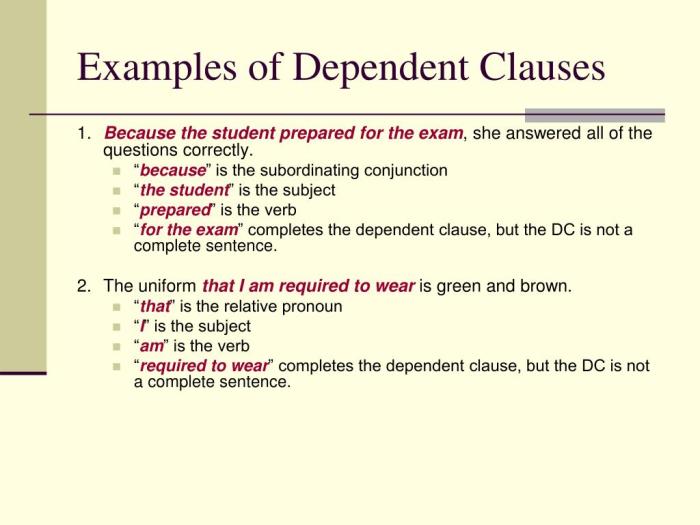
- The book that I borrowed is fascinating. (Modifies “book”)
- The city, where I grew up, is very different now. (Modifies “city”)
- Adverbial Clauses: These clauses function as adverbs, modifying verbs, adjectives, or other adverbs. They express various relationships, such as time, cause, condition, contrast, purpose, and result. They are introduced by subordinating conjunctions like “because,” “although,” “if,” “when,” “since,” “so that,” or “unless.”
- Examples:
- Because it rained, we stayed inside. (Modifies the verb “stayed”)
- She was happy when she received the news. (Modifies the adjective “happy”)
Identifying Each Type of Dependent Clause Based on Its Function
Successfully identifying the type of dependent clause hinges on understanding its role within the sentence. Analyzing its function, the words it begins with, and the information it provides are key strategies.
- Noun Clauses: To identify a noun clause, determine if it can be replaced by a noun or pronoun. Check if the clause functions as the subject, object, or complement of a verb or preposition.
- Adjective Clauses: Look for relative pronouns or adverbs. The clause will follow the noun or pronoun it modifies and provide descriptive details. Consider whether the clause answers the question “which one?” or “what kind?”.
- Adverbial Clauses: Identify the subordinating conjunction at the beginning of the clause. Consider the relationship the clause establishes with the independent clause (time, reason, condition, etc.). Ask yourself “when?”, “why?”, “how?”, or “under what circumstances?”.
“That the company will succeed is certain.” (The entire clause acts as the subject of the verb “is,” and can be replaced by a noun like “success.”)
“The car, which is red, belongs to my brother.” (The clause modifies “car” and answers the question “Which car?”)
“Although he was tired, he continued working.” (The clause explains the circumstances under which he continued working, using “although” to show contrast.)
Demonstrating the Contribution of Dependent Clauses to Sentence Variety and Complexity
Dependent clauses significantly enhance sentence variety and complexity, transforming simple statements into nuanced expressions. They allow for the integration of multiple ideas within a single sentence, creating a more sophisticated and engaging writing style. The following table illustrates how each type of dependent clause contributes to the richness and depth of a sentence:
| Clause Type | Function | Effect on Sentence Structure | Example |
|---|---|---|---|
| Noun Clause | Acts as a noun (subject, object, complement) | Adds complexity by incorporating an idea as a grammatical element within the main clause. | What they decided remains a mystery. (Subject of the sentence) |
| Adjective Clause | Modifies a noun or pronoun, providing additional information. | Adds detail and descriptive language, creating a more vivid image. | The house, which was built in 1920, has historical significance. |
| Adverbial Clause | Modifies a verb, adjective, or adverb, expressing a relationship (time, cause, condition, etc.) | Provides context and clarifies relationships between ideas, adding depth and nuance to the sentence. | Because of the weather, the flight was delayed. |
Mastering the Placement of Dependent Clauses Improves Sentence Structure and Clarity
The strategic positioning of dependent clauses is a cornerstone of effective writing, significantly impacting sentence structure, readability, and the nuanced conveyance of meaning. Understanding and applying the rules that govern their placement allows writers to craft sentences that are not only grammatically correct but also clear, concise, and engaging. This skill is crucial for achieving a polished writing style, enhancing comprehension, and ensuring the intended emphasis is effectively communicated to the reader.
Placement Rules and Their Impact
Dependent clauses, which cannot stand alone as complete sentences, can be positioned at the beginning, middle, or end of an independent clause. The placement of these clauses directly influences the flow and emphasis of the sentence. Beginning a sentence with a dependent clause often creates anticipation and sets the context. Placing it in the middle can provide additional information or qualify the main idea. Ending a sentence with a dependent clause typically provides a conclusion or explanation, placing the focus on the independent clause’s core message. Violating these principles can lead to awkward sentence construction, hindering comprehension and potentially altering the intended meaning.
The rules are straightforward, yet their application requires careful consideration of the overall message. Consider these key guidelines:
* Placement at the Beginning: A dependent clause at the beginning, followed by a comma, provides context or background information. This approach is often used for emphasis or to introduce a cause-and-effect relationship.
* Placement in the Middle: When placed in the middle of a sentence, a dependent clause is usually set off by commas (or dashes) and provides additional, non-essential information. This can add detail without disrupting the flow.
* Placement at the End: Ending a sentence with a dependent clause offers a concluding remark or explains the preceding independent clause. This placement is common for providing reasons, results, or consequences.
Shifting Emphasis Through Clause Placement
Changing the position of a dependent clause can significantly alter the meaning and focus of a sentence. This ability to manipulate emphasis is a powerful tool for writers. Consider these examples:
* Original: Because the market conditions were unfavorable, the company reported lower profits.
* Emphasis: The unfavorable market conditions are presented as the primary reason for the lower profits.
* Revised: The company reported lower profits because the market conditions were unfavorable.
* Emphasis: The lower profits are the primary focus, with the market conditions providing the explanation.
* Original: While the team worked diligently, the project faced delays.
* Emphasis: The diligence of the team is juxtaposed with the project delays.
* Revised: The project faced delays, while the team worked diligently.
* Emphasis: The project delays are the primary focus, with the team’s diligence presented as a contrasting element.
These examples illustrate how the same information can be presented with different focal points, simply by shifting the dependent clause’s position.
Enhancing Sentence Flow with Strategic Placement
Strategic placement of dependent clauses can drastically improve sentence flow and create a more polished writing style. Here are several sentence variations to illustrate this:
* Scenario: Describing a research finding.
* Version 1 (Less Polished): The study found a correlation, even though the sample size was small.
* Version 2 (More Polished): Even though the sample size was small, the study found a correlation.
* Version 3 (Most Polished): The study found a correlation, although the sample size was small.
* Scenario: Explaining a business decision.
* Version 1 (Less Polished): The company expanded into a new market because they saw significant growth potential.
* Version 2 (More Polished): Because they saw significant growth potential, the company expanded into a new market.
* Version 3 (Most Polished): The company, seeing significant growth potential, expanded into a new market.
The last version of each scenario showcases a more sophisticated sentence structure, employing a middle-placed dependent clause for a smoother flow and potentially greater impact. Mastering these techniques elevates the writing from functional to elegant and persuasive.
Punctuating Dependent Clauses Correctly Ensures Grammatical Accuracy
Correct punctuation is essential for clarity and readability in writing. Proper punctuation of dependent clauses, specifically, plays a critical role in conveying the intended meaning of a sentence and avoiding ambiguity. Mastering these punctuation rules is crucial for producing grammatically sound and professional-quality writing.
Punctuating Dependent Clauses: Rules and Applications
The punctuation of dependent clauses hinges on their position within a sentence. The primary tool for punctuating dependent clauses is the comma. Understanding the placement of commas relative to the dependent clause is key to achieving grammatical accuracy.
* Dependent Clause at the Beginning of a Sentence: When a dependent clause initiates a sentence, it is followed by a comma. This comma separates the introductory clause from the independent clause that follows. For example: “Because the market was volatile, investors remained cautious.” In this sentence, the dependent clause “Because the market was volatile” is followed by a comma, which is then followed by the independent clause “investors remained cautious.”
* Dependent Clause in the Middle of a Sentence: If a dependent clause interrupts the flow of an independent clause, it is typically enclosed by commas. This is similar to how we would treat parenthetical information. The commas act as visual cues, signaling that the information within the dependent clause is supplemental. For example: “The company, which had reported record profits, announced a stock buyback.” Here, the dependent clause “which had reported record profits” is sandwiched between commas, clarifying its modifying role. There are exceptions to this rule. If the dependent clause is essential to the meaning of the independent clause, no commas are used. Consider this: “The report that was leaked contained sensitive information.” The dependent clause “that was leaked” is essential; therefore, it does not require commas.
* Dependent Clause at the End of a Sentence: When a dependent clause concludes a sentence, it is usually preceded by a comma. This structure separates the independent clause from the modifying dependent clause. For example: “The deal was finalized, although some concerns remained.” The comma before “although some concerns remained” correctly separates the independent clause from the dependent clause.
The correct use of commas with dependent clauses prevents misinterpretations. Without proper punctuation, sentences can become confusing or even misleading. Punctuation provides the necessary framework for readers to follow the writer’s train of thought accurately.
Commas and Dependent Clauses: Examples of Correct and Incorrect Usage
Commas are crucial for correctly punctuating dependent clauses. Their placement dictates the sentence’s meaning and readability. Misplaced commas or their omission can alter the intended message.
* Correct Usage:
* “After the economic data was released, the market experienced a surge.” (Dependent clause at the beginning, comma used)
* “The CEO, who was known for his strategic vision, addressed the shareholders.” (Dependent clause in the middle, commas used)
* “The project was completed on time, even though there were several challenges.” (Dependent clause at the end, comma used)
* Incorrect Usage:
* “Because of the recession the company saw a decline in profits.” (Missing comma after the introductory dependent clause)
* “The new policy which was poorly received, led to a public outcry.” (Unnecessary comma before “which”)
* “The report was delayed because of unexpected technical difficulties” (Missing comma before the dependent clause)
Proper punctuation ensures clarity. These examples illustrate the importance of commas in correctly structuring sentences containing dependent clauses. The absence or misuse of commas can create ambiguity and hinder effective communication.
Practice Exercises: Punctuation of Dependent Clauses
Practice is essential for mastering the punctuation of dependent clauses. The following exercises provide opportunities to apply the rules discussed above.
| Sentence | Correct Punctuation | Explanation |
|---|---|---|
| If the interest rates rise investors will likely sell their bonds. | If the interest rates rise, investors will likely sell their bonds. | The dependent clause “If the interest rates rise” begins the sentence and is followed by a comma. |
| The company’s stock which had been performing well took a downturn. | The company’s stock, which had been performing well, took a downturn. | The dependent clause “which had been performing well” is in the middle of the sentence and is enclosed by commas. |
| He decided to invest although the market was uncertain. | He decided to invest, although the market was uncertain. | The dependent clause “although the market was uncertain” concludes the sentence and is preceded by a comma. |
| Since the merger was announced the share price has increased. | Since the merger was announced, the share price has increased. | The dependent clause “Since the merger was announced” begins the sentence and requires a comma. |
| The data that was collected yesterday provided valuable insights. | The data that was collected yesterday provided valuable insights. | The dependent clause “that was collected yesterday” is essential and therefore does not require commas. |
Avoiding Common Errors Associated with Dependent Clauses Prevents Misunderstandings
Understanding and correctly using dependent clauses is essential for clear and effective communication. However, even experienced writers can make mistakes, leading to confusion and misinterpretation. Avoiding these common errors is crucial for ensuring your writing is easily understood and grammatically sound. This section explores frequent pitfalls associated with dependent clauses and provides strategies for avoiding them.
Comma Splices and Run-on Sentences
Comma splices and run-on sentences are among the most prevalent errors involving dependent clauses. They often arise from a misunderstanding of how independent and dependent clauses should be combined. These errors disrupt the flow of writing and can make it difficult for readers to follow the intended meaning.
A comma splice occurs when two independent clauses are joined only by a comma. An independent clause is a group of words that can stand alone as a complete sentence. Using only a comma to connect two independent clauses creates a grammatically incorrect sentence.
For example:
* Incorrect: *The rain poured, the game was canceled.*
This sentence contains two independent clauses: “The rain poured” and “the game was canceled.” They are improperly joined by a comma.
A run-on sentence, on the other hand, occurs when two or more independent clauses are joined without any punctuation or with incorrect punctuation. It’s essentially a more severe version of a comma splice, where the clauses run together without clear separation.
For example:
* Incorrect: *I went to the store I needed groceries.*
This is a run-on sentence because it combines two independent clauses (“I went to the store” and “I needed groceries”) without any punctuation or a conjunction to connect them.
Correcting these errors involves several strategies:
1. Using a coordinating conjunction: You can join two independent clauses with a comma and a coordinating conjunction (for, and, nor, but, or, yet, so).
* Correct: *The rain poured, so the game was canceled.*
2. Using a semicolon: A semicolon can be used to join two closely related independent clauses.
* Correct: *The rain poured; the game was canceled.*
3. Separating into two sentences: The simplest solution is often to separate the independent clauses into two distinct sentences.
* Correct: *The rain poured. The game was canceled.*
4. Using a dependent clause: If one of the clauses is less important, it can be made into a dependent clause and joined to the independent clause.
* Correct: *Because the rain poured, the game was canceled.*
Strategies for avoiding comma splices and run-on sentences include careful proofreading and sentence restructuring.
- Proofreading: Read your work carefully, paying close attention to sentence structure. Identify independent and dependent clauses and ensure they are correctly punctuated.
- Sentence restructuring: Vary your sentence structure to avoid monotony and to make your writing clearer. Combine short sentences and break down long, complex sentences when necessary.
- Using Grammar Checkers: Employing grammar-checking software can assist in identifying these errors. These tools highlight potential comma splices and run-on sentences, allowing you to review and correct them.
- Reading Aloud: Reading your writing aloud can help you identify run-on sentences or comma splices. The natural pauses and flow of speech will reveal where punctuation is needed.
These strategies, combined with a solid understanding of dependent and independent clauses, will significantly improve the clarity and accuracy of your writing.
Final Summary
In essence, mastering the dependent clause unlocks a new level of grammatical sophistication. By understanding its components, types, placement, and punctuation, writers can elevate their craft, achieving clarity, precision, and a captivating style. The ability to use dependent clauses effectively not only enhances grammatical accuracy but also empowers writers to express complex thoughts with greater finesse. Armed with the knowledge provided, you are now ready to harness the power of dependent clauses and elevate your writing to new heights.
